

Structured Play: Building Problem-Solving Skills Through Fun

Listen to this Article
Have you ever watched your child's face light up when they finally solve a challenge that had them stumped? That magical "I did it!" moment isn't just heartwarming—it's brain-building! Problem-solving structured play offers the perfect blend of fun and learning that helps children develop crucial thinking skills they'll use throughout life.
What Is Structured Play for Problem-Solving?
Structured play involves activities with gentle guidance or simple challenges that encourage children to find solutions. Unlike completely free play where children direct everything, these activities include thoughtful elements designed to promote specific skills while still being enjoyable and largely child-driven.Think of building challenges, simple science experiments, or games with rules. These activities provide just enough structure to encourage thinking without stifling creativity—making them powerful tools for development.
"In thoughtfully designed structured play, we're not telling children what to learn; we're creating situations where they discover solutions through their own thinking and experimentation."
How This Type of Structured Play Benefits Your Child
When children engage in structured activities that require finding solutions, they develop skills that go far beyond the play moment:
- Critical thinking: Evaluating what works and what doesn't
- Persistence: Trying different approaches until finding one that succeeds
- Creativity: Discovering novel solutions to challenges
- Confidence: Building belief in their ability to overcome obstacles
Research shows that these early experiences form neural pathways that influence how children approach challenges throughout life. In essence, structured play teaches children how to think, not what to think.
What Type of Play Develops These Skills?
Different types of structured activities naturally encourage critical thinking in unique ways:
Building and Construction Play
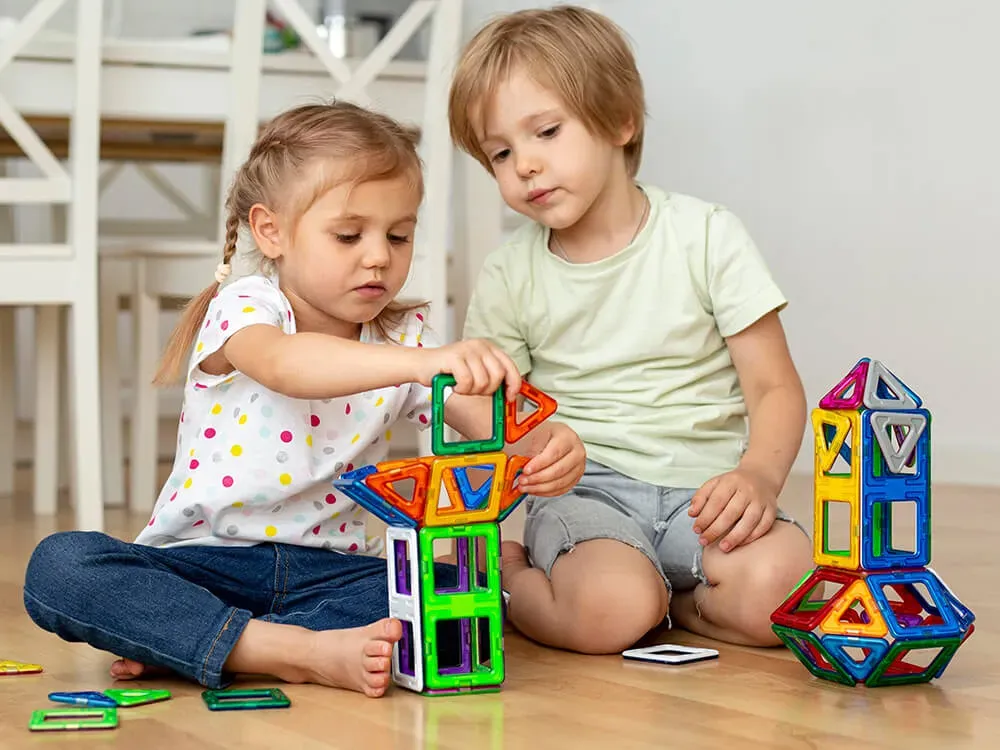
When your child plays with blocks, construction sets, or even cardboard boxes, they encounter challenges like balance, stability, and spatial relationships. This type of play naturally promotes engineering thinking and persistence.
Strategy Games and Puzzles
Simple board games, card matching, and age-appropriate puzzles help children develop logical thinking and the ability to plan ahead. Even games like tic-tac-toe introduce strategic thinking!
Sensory Exploration with Purpose
Water play, sandbox activities, and simple science experiments allow children to form theories and test them—the foundation of scientific thinking and hypothesis testing. These sensory play activities engage multiple senses simultaneously while encouraging children to make predictions and discover cause-and-effect relationships
Creative Challenges
Art projects with specific goals (like "create something that can float") combine creativity with analytical thinking in ways that help children build innovative approaches to challenges.
Examples of Structured Play at Home
You don't need expensive educational materials! Here are simple structured activities you can try today:
For Toddlers (1-3 years)
- Shape Fitting Fun: Instead of just using a shape sorter normally, try placing it slightly out of reach with tools like spoons or sticks nearby. This simple adjustment transforms a familiar toy into an opportunity to figure things out.
- Obstacle Courses: Create a simple path around furniture with challenges like "go under," "go over," and "go around." This physical play helps develop spatial awareness and planning.
For Preschoolers (3-5 years)

- Rescue Mission: Place a favorite small toy in a container that's difficult to reach into directly. Provide tools like tongs, string, or uncooked spaghetti. Can your child figure out how to "rescue" their toy? This activity builds critical thinking and persistence.
- Building Challenges: "Can you build a home for this toy animal that will keep it dry if it rains?" (Then test with a gentle sprinkle of water!) This structured play often leads to multiple attempts and refinements.
For Early Elementary (5-8 years)
- Marble Run Challenges: Rather than following instructions to build a marble run, give your child the pieces and a simple goal: "Create a path that will take the marble from the table to this bucket." The open-ended nature encourages experimentation.
- Simple Machines Investigation: Challenge your child to move something heavy using only simple tools. This play involves activities that connect to real-world physics and engineering concepts.
What Are the Benefits of Structured Play?
The benefits of structured play that focuses on finding solutions extend across all areas of development:
Cognitive Growth
- Strengthens analytical thinking
- Develops planning abilities
- Improves focus and attention span
- Builds memory skills through trial and error
Emotional Development
- Builds frustration tolerance
- Develops a growth mindset through overcoming challenges
- Creates healthy relationships with mistakes as learning opportunities
- Fosters confidence from successfully solving problems
Social Skills
- Encourages communication when working together
- Develops turn-taking and cooperation
- Builds empathy and perspective-taking
- Helps children understand others' thinking
Academic Readiness
- Forms the foundation for later math concepts
- Introduces scientific method through experimentation
- Expands vocabulary as children discuss their processes
- Prepares children for classroom-based learning
Balancing Structure and Freedom in Play
While thoughtfully designed structured play offers tremendous benefits, balance remains essential. Children need both guided experiences AND the freedom of completely open-ended play:
- Structured play provides focused learning opportunities and introduces new concepts
- Unstructured play allows for imagination, creativity, and self-direction
- Free play allows children to process what they've learned and apply it in ways we might never imagine
The sweet spot is a balance between structured and unstructured play experiences throughout your child's day, with plenty of time for both approaches.
Supporting Thinking Skills During Play
How you interact during structured play significantly impacts its benefits:
Do:
- Allow adequate time for thinking and experimentation
- Ask open-ended questions: "What might happen if...?"
- Acknowledge effort: "You're really thinking carefully about this!"
- Offer minimal hints if needed: "Have you tried looking at it from another angle?"
Avoid:
- Solving challenges for your child
- Rushing the process
- Focusing only on "correct" solutions
- Comparing your child's approach to others
Remember that struggle is a valuable part of learning—the magic happens in those moments of productive effort when children are figuring things out!
What to Look for in Quality Childcare Programs
When evaluating childcare or early education options, look for programs that understand the value of thoughtfully designed structured play:
- Do they create challenges that encourage children to find solutions?
- Can they explain how structured activities promote specific skills?
- Do they allow adequate time for children to work through difficulties?
- Do they document children's thinking processes?
- Is there a healthy balance between structured and unstructured activities?
Incorporating Quality Structured Play at Home
You can easily add more solution-oriented structured play to your family routine:
During Everyday Activities
- Cooking together becomes mathematical reasoning
- Folding laundry involves spatial relationships and sorting
- Shopping introduces budgeting and decision-making
Through Thoughtful Questions
Transform ordinary play by asking:
- "How could you make that taller without it falling?"
- "What might happen if we try it this way?"
- "Can you think of another way to solve this?"
By Setting Up Simple Challenges
- "Can you build something that will roll down this ramp?"
- "How could we water the plants without using the watering can?"
- "What could we use to make music without using toys?"
These simple interactions extend thinking without taking over the play experience.
The Power of Learning Through Play
In today's achievement-focused world, it's easy to underestimate play's importance. Yet research consistently shows that well-designed structured play builds the executive function skills that predict academic success better than early academics alone.When children engage in play that requires thinking, experimenting, and overcoming challenges, they're not just having fun—they're building neural pathways that will serve them throughout life. These early experiences form the foundation for how they'll approach everything from math problems to workplace challenges in the future.
Looking for quality childcare providers who understand the importance of learning through play? Visit KinderPage Canada's premier directory for connecting families with childcare providers who value developmentally appropriate practices like structured play that builds critical thinking skills.What engaging structured play activity will you try with your child this week? The skills they build today will become the foundation for tomorrow's success!
About the Author
Mary Abbasi
Contributing writer at KinderPage, sharing insights about childcare and early childhood education in Canada.
Frequently Asked Questions
What is problem-solving structured play?
How does structured play benefit a child's development?
What types of activities best develop problem-solving skills in structured play?
Can you provide examples of structured play activities for different age groups?
How can parents support their child's thinking skills during structured play?
What is the importance of balancing structured and unstructured play?
How can structured play be incorporated into everyday home activities?
Why is problem-solving structured play considered so powerful for a child's future success?
Related Articles
Continue reading about childcare and early education


